
Remembering George W. Bush: Governor, President, and Man of Conviction
Honoring the Man Whose Life and Presidency Were Shaped by Faith, Courage, and Steady Resolve
July 6, 2026 | 6-minute read
There are moments in history when leadership is tested without warning.
Moments when comfort disappears, certainty collapses, and responsibility arrives without invitation.
George W. Bush did not seek those moments.
But when they came, he did not step away.
He stepped forward.
This post continues my series, Three Lives, One Steady Character—a reflection on leaders whose public responsibilities never eclipsed the private character that defined them.
Bush lived three distinct lives: governor, president, and private citizen. And across each role, the same steady character remained.
Bush the Governor: Leadership Forged in Responsibility

Before he became president, Bush served as governor of Texas.
It was there that his leadership style took shape—not in front of the world, but in service to a single state and its people.
He approached the office with clarity and purpose.
He listened. He learned. He governed.
He demonstrated that leadership was not about commanding attention, but about accepting responsibility.
He built consensus. He made decisions. He accepted accountability.
He did not govern for recognition.
He governed because the responsibility was his to carry.
Character Revealed Before the Spotlight
True leadership rarely begins on the national stage.
It begins quietly, long before history is watching.
Bush’s years as governor revealed the qualities that would later define his presidency: conviction, steadiness, and an unshakable sense of duty.
He did not yet know what history would ask of him.
But he was preparing to answer it.
Bush the President: Steadfast Under Unimaginable Pressure

On September 11, 2001, the world changed.
And Bush, without warning, became a wartime president.
In that moment, leadership was no longer theoretical.
It was immediate.
Personal.
Permanent.
He carried the burden of decisions that would affect not only his nation, but the world.
He did not retreat from that responsibility.
He faced it.
He spoke to a grieving nation. He steadied its fears. He accepted the weight of protecting its future.
He understood that leadership, in its hardest moments, means standing firm when others are shaken.
Conviction in the Face of History
Leadership is often measured not by ease, but by endurance.
Bush made decisions knowing they would be debated, questioned, and remembered.
He made them anyway.
Because he believed leadership required action, not avoidance.
He carried responsibility without surrendering to fear.
He accepted isolation without abandoning conviction.
And he remained steady.
Bush the Private Man: Returning to the Life That Grounded Him

When his presidency ended, Bush did what strong leaders often do.
He stepped away.
He returned to Texas. To his ranch. To the quiet life that had always grounded him.
He did not cling to the spotlight.
He returned to himself.
He spent his time painting, reflecting, and living as a private citizen once more.
He understood something many never do.
Leadership is a chapter.
Not an identity.
The Man Who Never Stopped Being Himself
Power changes many people.
It did not change him.
The same faith. The same humor. The same grounded character remained.
He had carried responsibility.
And then, as all true leaders must, he released it.
Three Lives, One Steady Character
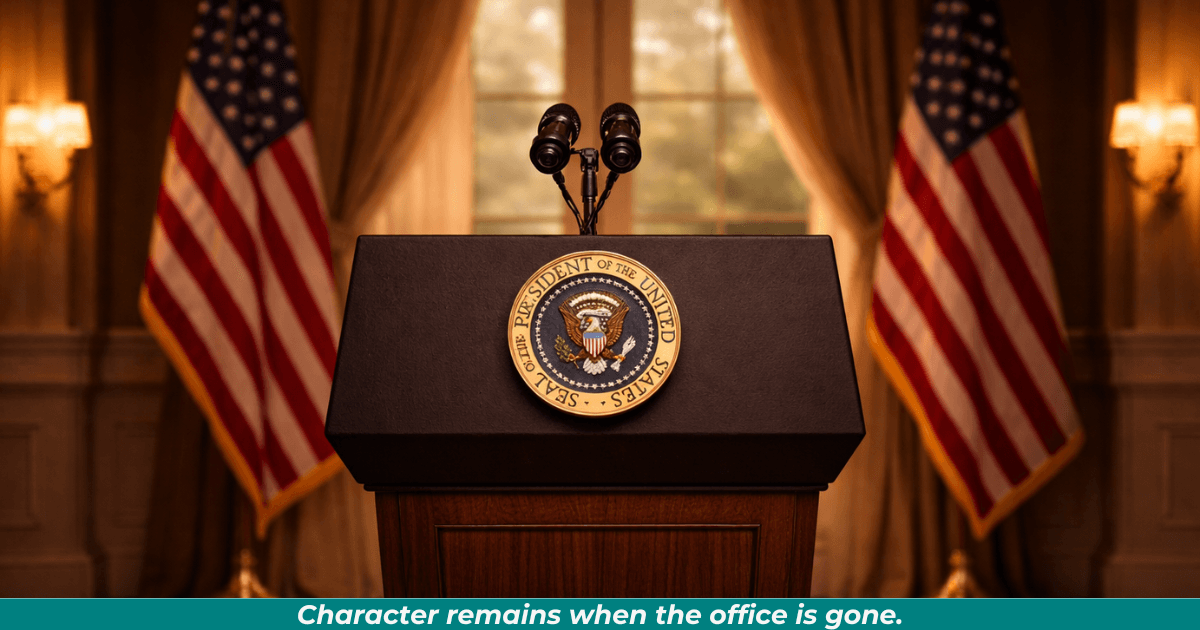
Governor. President. Private citizen.
Three roles. One steady character.
Bush demonstrated that leadership is not defined by popularity, but by conviction.
Not by comfort, but by courage.
Not by ease, but by endurance.
He accepted responsibility when history placed it upon him.
He carried it faithfully.
And when his service was complete, he stepped away.
The Character That Endures
Public office ends.
Character does not.
In the years since leaving the presidency, Bush has shown that leadership does not disappear when the office does.
It simply reveals itself more quietly.
Time and again, in moments when former presidents have gathered—moments meant to reflect continuity rather than conflict—Bush has been seen offering small, human gestures of kindness.
🎖️ A word of comfort.
🎖️ A shared moment of humor.
🎖️ A simple act of compassion when someone nearby was hurting.
These were not political gestures.
They were personal ones.
They reflected something deeper than office.
They reflected character.
He demonstrated that kindness does not require agreement. That compassion does not require allegiance. That dignity does not depend on recognition.
He showed, in quiet ways, that strength and gentleness are not opposites.
They are companions.
Bush’s life reminds us that leadership is not measured only by the weight of decisions made in office, but by the steadiness of the person who remains when the office is gone.
And that steadiness—the quiet consistency of faith, conviction, humility, and compassion—is what endures.
Next time: On Wednesday, we’ll begin a brand-new phase—The Audience Clarification series starting with:
“Why I Write for Women Who Feel Misunderstood.”
Which quality do you most admire in a leader—faith, courage, conviction, or humility?
Share your thoughts in the comments or send me a note. I’d love to hear which leaders have shaped your understanding of character—and why.
Related Topics: Presidential leadership • Faith and leadership • American history • Character and legacy • Texas heritage • Three Lives, One Steady Character series
All images courtesy of ChatGPT.

Alicia Strickland
Hi! I write across multiple genres under various pen names. But for nonfiction, I write as myself.
As a designer with a love of Old Hollywood and all things creative, I bring diverse perspectives to my storytelling... and to my blog.
In the unlikely event that I’m not writing, I enjoy crafting, gardening, or spending time with my flame-point Siamese, Hunter.
Want to stay updated? Sign up for my newsletter (below 👇) to receive exclusive content and be the first to hear about new releases!
YOU MIGHT LIKE

Jan 08, 2025
Jan 08, 2025
POPULAR POSTS
By Alicia Strickland on February 14, 2025

By Alicia Strickland
Jan. 05, 2025
REVIEWS

Jan 15, 2025
Dec 29, 2024
Jan 20, 2025
Feb 14, 2025

Crafting passionate tales for adult hearts and creating magical worlds for young minds!
Stay in touch!
Click “subscribe” to get weekly newsletter updates on all BBA news and books.
©️ 2026 booksbyalicia.com