
Remembering George Washington: Soldier, Statesman, and Servant Leader
Honoring the Reluctant Hero Who Shaped America’s First Principles
February 22, 2026 | 8-minute read
There is a difference between holding office and holding character.
In our modern world, titles are often pursued. Power is sought. Influence is chased.
But George Washington never chased power.
He answered duty.
That is why, while I do not personally observe Presidents’ Day as a broad celebration of all who have held the office, I do pause to remember George Washington himself. Because he was not simply the first president.
He was the standard.
This post is part of the series I call Three Lives, One Steady Character—a reflection on leaders whose public roles never eclipsed the private character that defined them.
Washington lived three distinct lives: soldier, president, and private citizen. And yet across each role, the same steady character remained.
Washington the Soldier: Leading From the Front
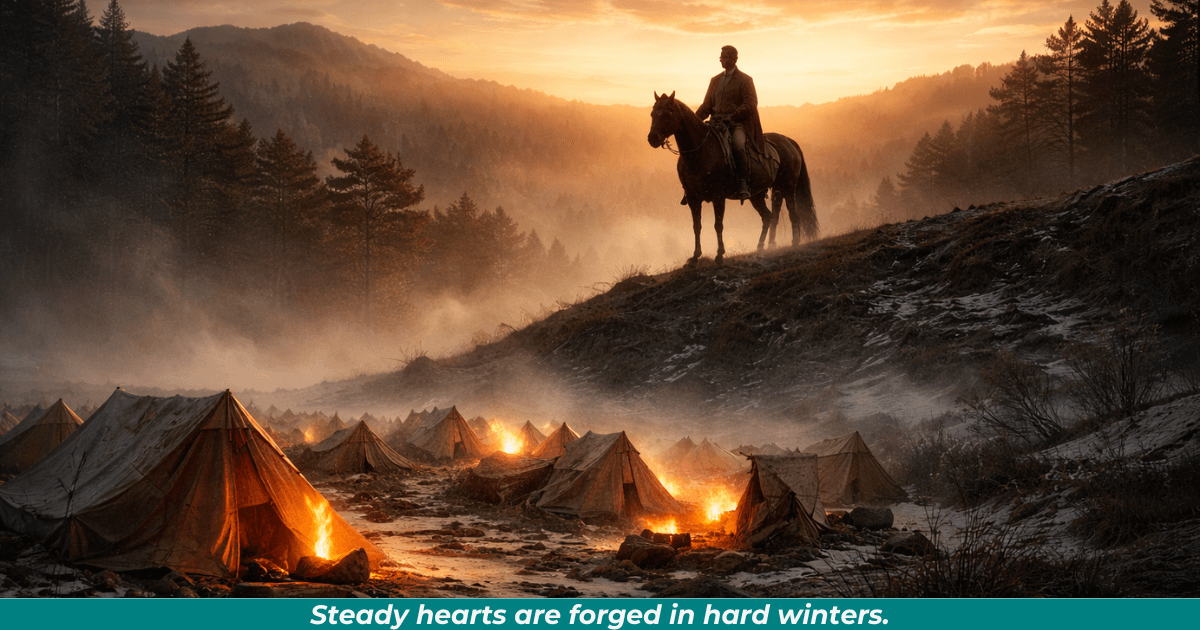
Long before he became president, Washington was a soldier—one forged in uncertainty, hardship, and impossible odds.
He did not inherit a ready-made army. He helped build one.
The Continental Army was underfunded, undertrained, and often undersupplied. Soldiers endured brutal winters, scarce provisions, and the constant uncertainty of survival. Yet Washington stayed with them. He did not govern from comfort. He endured what they endured.
He was not perfect. He faced defeats, doubt, setbacks, and moments of grave risk. But he did not abandon his post.
He remained steady.
Those who served under him trusted him—not because he promised ease, but because he shared their burden.
He understood something many leaders forget: authority is not proven in victory, but in endurance.
It was his perseverance, his restraint, and his unwavering sense of responsibility that ultimately carried the army—and the fragile new nation—forward.
Endurance before Victory
Washington’s military strength was not defined by easy triumphs, but by perseverance through uncertainty.
He faced:
Severe winters without adequate shelter
Soldiers lacking food, clothing, and pay
Constant threat from a better-equipped enemy
Pressure from Congress and critics
The fragile hope of a nation not yet fully born
And yet, he remained.
He did not abandon his men. He did not abandon the cause.
He understood something deeper than tactics—that leadership means standing firm when everything else falters.
Victory did not come quickly.
But when it came, it validated the kind of leadership that refuses to abandon its post—no matter how long the cost.
Washington the President: The Reluctant Architect of an Office
Washington never campaigned for the presidency.
He was asked to accept it.
The nation, newly formed and uncertain, needed a leader people trusted. Washington had already proven he could wield authority without clinging to it. That alone made him uniquely qualified.
When he became president, there was no blueprint. Every decision he made and every action he took would define the office itself—not just for his time, but for generations.
He approached the role with restraint.
He understood the presidency was not meant to become a throne.
So he accepted the responsibility with reverence, not ambition and did so only long enough to secure the republic.
Perhaps his greatest act of leadership was not accepting power—but refusing to let it define him.
After two terms, he stepped away voluntarily. He refused to remain indefinitely, even though he could have.
He understood something deeper than politics.
A republic must never depend on one man.
It must depend on principles.
In stepping aside, he established a precedent that would protect the nation long after his lifetime—the peaceful transfer of power.
He did not seek to become indispensable.
He sought to ensure the nation would endure without him.
And that is what a true leader does.
Power Held in Trust, Not Possession
Washington never viewed the presidency as something to keep.
He viewed it as something entrusted to him—temporarily, reverently, and with accountability to something greater than himself.
He established precedents that still shape the office today:
Respecting Constitutional limits
Refusing lifelong rule
Prioritizing national unity over personal authority
Exercising restraint even when he held unquestioned influence
Demonstrating that leadership must remain accountable to the people
This was unheard of in a world accustomed to kings and rulers who governed for life.
Washington chose a different path.
He proved that authority is strongest when it is exercised with humility—and surrendered with integrity.
He did not cling to power.
He returned it to the people.
Washington the Private Man: The Steward of Mount Vernon
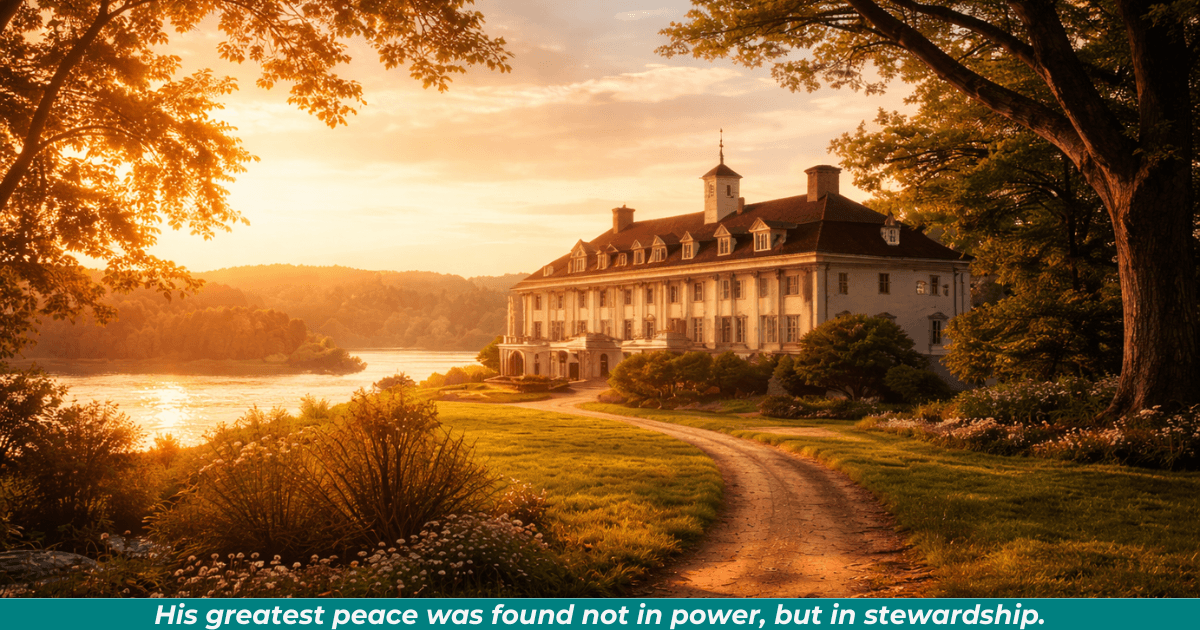
The most lasting leadership often happens far from applause.
To understand Washington fully, one must understand Mount Vernon.
It was not merely his home. It was where he returned whenever duty released him. It was where he lived not as general or president, but as a man.
Mount Vernon stood along the Potomac River—peaceful, ordered, and carefully stewarded. Washington oversaw its operations personally. He studied agriculture, improved his land, and took pride in building something lasting and productive.
He was not driven by the spotlight.
He was drawn to stewardship and took it seriously.
Time and again, he left Mount Vernon only when called. And time and again, he returned when his service was complete.
He did not measure his worth by how long he held power, but by how faithfully he fulfilled responsibility.
Like later leaders who found grounding on their own land and ranches, Washington found clarity at Mount Vernon. It reminded him who he was beyond title or office.
He was, at his core, a citizen entrusted with temporary responsibility—not a ruler entitled to permanent authority.
The Man Who Wanted to Go Home
Mount Vernon was not an escape from responsibility. It was the place that reminded him who he was beyond it.
There, he was not General Washington. Not President Washington.
He was simply George Washington.
Husband to Martha
Steward of his land
Student of agriculture
Private citizen
He walked his fields. He managed crops. He improved the estate with care and intention.
Again and again, when his service was complete, he resumed the quiet life he had never intended to leave behind.
Not to withdraw from the nation—but to live as one of its citizens.
This was always his goal.
Not to rule America.
But to serve her—and then return to ordinary life.
Three Lives, One Steady Character
Soldier. President. Private citizen.
Three roles. One character.
Washington demonstrated that true leadership is not defined by ambition, but by restraint.
Not by seizing power, but by stewarding it wisely—and releasing it when the time comes.
He remains worthy of remembrance not simply because he was first, but because he set the tone for what leadership could be.
He showed that strength and humility are not opposites.
They are companions.
And long after titles fade, it is character that endures.
That is why George Washington is still and should always be remembered.
The Standard He Set
Washington did more than lead.
He defined what leadership could be.
He showed that a leader can be:
Strong without seeking dominance
Trusted without demanding loyalty
Respected without demanding praise
Faithful without needing recognition
Powerful without becoming permanent
He lived three lives—soldier, president, and private citizen—but he remained the same man in each.
🎖️ Steady.
🎖️ Grounded.
🎖️ Faithful to duty.
And because of that, his legacy did not end when he left office.
It began.
Next time: We’ll turn our attention to March’s literary observances, including National Reading Month, Read an E-Book Month, Read Across America Day, and National Proofreading Day—celebrating the stories, words, and readers who keep literature alive.
As you reflect on George Washington’s life, I invite you to consider this:
What quality defines true leadership?
Is it strength? Humility? Faithfulness? The willingness to step forward—or the wisdom to step aside?
Share your thoughts in the comments. I’d love to hear which leaders have shaped your understanding of character—and why remembering them still matters.
Related Topics: Presidential leadership • Faith & culture • American history • Servant leadership • Founding Fathers • Character and leadership • Mount Vernon and early America • Three Lives, One Steady Character series
All images courtesy of ChatGPT.

Alicia Strickland
Hi! I write across multiple genres under various pen names. But for nonfiction, I write as myself.
As a designer with a love of Old Hollywood and all things creative, I bring diverse perspectives to my storytelling... and to my blog.
In the unlikely event that I’m not writing, I enjoy crafting, gardening, or spending time with my flame-point Siamese, Hunter.
Want to stay updated? Sign up for my newsletter (below 👇) to receive exclusive content and be the first to hear about new releases!
YOU MIGHT LIKE

Jan 08, 2025
Jan 08, 2025
POPULAR POSTS
By Alicia Strickland on February 14, 2025

By Alicia Strickland
Jan. 05, 2025
REVIEWS

Jan 15, 2025
Dec 29, 2024
Jan 20, 2025
Feb 14, 2025

Crafting passionate tales for adult hearts and creating magical worlds for young minds!
Stay in touch!
Click “subscribe” to get weekly newsletter updates on all BBA news and books.
©️ 2026 booksbyalicia.com